Crossword Results

If you like Crossword puzzles, save this page. We will use the same link for future crosswords.

#

Clue

Answer

2 Across

A place that provides 24-hour care in a home-like setting (abbr.)

AFH

4 Across – A plan for future medical care – Advance Directive

5 Across – Short-term care for recovery after a hospital stay (abbr.) – SNF

1 Down – Help with daily activities in your own home (3 words) – In-Home Care

3 Down – A government program that helps with long-term care costs – Medicaid

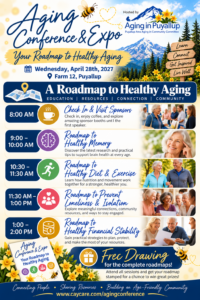
Aging Conference & Expo 2027

We are so excite to announce this upcoming event! Aging in Puyallup has been around for over 20 years focusing on healthy aging. Join us as we look at the 5 most important areas of healthy aging!

Get a Roadmap to Healthy Aging where our vendors will teach you about the resources near you.

Enjoy a catered Lunch by Farm 12, it is going to be a Power Packed Day. $10.00 |$20.00 | $30.00

Aging Conference & Expo Guest Registration

Step 1 of 3

Aging Conference & Expo Registration

Name(Required)
Email(Required)

Aging Conference & Expo

Aging Conference – April 28th, 2027 Hosted & Managed by Aging in Puyallup

This event will begin at 9:00 AM and end 2:00 PM Wednesday, April 28th, 2027. The conference will host 4 speakers, lunch, and a Roadmap to Healthy Aging.

There are many sponsorship opportunities. If you are interested sign up below.


Aging Conference Vendor & Sponsorship Form

Step 1 of 3

Vendor/Sponsorship Contact Details

Name(Required)
Email(Required)

Over 70 and Never Had a Heart Attack 

Over 70 and Never Had a Heart Attack 

New statin research may change the conversation 

The important caution comes first: this study is not a reason for every older adult to begin a statin. It is a strong reason for some adults over 70 to revisit the question with their healthcare provider. 

For years, physicians have had limited randomized-trial evidence about whether otherwise healthy adults should start cholesterol-lowering medication after age 70. A major study published August 29, 2026, in the New England Journal of Medicine helps fill that gap. 

What the researchers discovered 

The STAREE trial included 9,971 community-dwelling Australians age 70 and older who had no history of cardiovascular disease, diabetes, or dementia. Participants were randomly assigned to take either 40 mg of atorvastatin each day or a placebo and were followed for a median of 5.9 years. 

30%
lower risk of a first major cardiovascular event 
37
people treated for nearly six years to prevent one event 
5.9 years
median follow-up in the trial 

Compared with placebo, atorvastatin reduced the risk of a first major cardiovascular event, including heart attack, stroke, cardiovascular death, or a coronary procedure. Researchers recorded 297 events in the statin group and 412 in the placebo group. 

What the medication did not do 

The medication did not significantly extend disability-free survival. Participants taking atorvastatin did not live significantly longer without death, dementia, or persistent physical disability. Serious adverse events were similar between the groups. 

The evidence supports fewer cardiovascular events among the people studied. It does not establish that statins help every older adult live longer, prevent dementia, or remain independent. 

Who might be affected 

The findings apply most directly to relatively healthy, independently living adults age 70 or older who have not previously experienced cardiovascular disease and do not have diabetes or dementia. 

Important limitation: the trial does not directly answer the same question for people who are frail, have significant cognitive impairment, live with multiple complex illnesses, or have a limited life expectancy. Participants were also almost entirely White and lived in Australia, which may limit how broadly the findings apply. 


CAYCARE COMMUNITY HEALTH NEWSLETTER 

Do not start or stop a statin on your own 

A treatment decision should consider more than age or one cholesterol number. A clinician should review the person’s cardiovascular risk, current medications, possible interactions, health goals, life expectancy, and willingness to take a daily medication. 

For some healthy adults over 70, preventing a first heart attack or stroke may outweigh the inconvenience or possible side effects of another medication. For someone experiencing frailty, medication burden, muscle symptoms, or advanced illness, the balance may look different. 

Questions to take to the next appointment 

  • What is my personal risk of having a heart attack or stroke? 
  • Would the people studied in this trial be considered similar to me? 
  • How much might a statin reduce my individual risk? 
  • Could it interact with my current medications? 
  • What side effects should I report? 
  • When would we reconsider whether I should continue taking it? 
  • Does this treatment fit my health priorities and long-term goals? 

Bring an updated medication and supplement list. If several specialists prescribe medications, ask who will monitor the complete plan. 

What you can do now 

  • Do not change cholesterol medication without medical guidance. 
  • Schedule a medication and cardiovascular-risk review if you are over 70 and unsure whether a statin is appropriate. 
  • Ask for the potential benefit in understandable terms: “Out of 100 people like me, how many might avoid a heart attack or stroke?” 
  • Discuss blood pressure, smoking, physical activity, nutrition, and diabetes screening alongside medication. 
  • Share the plan with the person who helps manage appointments or prescriptions. 

The larger lesson 

Older adults are often treated using research conducted in younger populations. This large randomized trial provides stronger age-specific evidence, but good care still requires an individualized decision—not a one-size-fits-all message. 

Churches, senior centers, and senior living communities can help by encouraging medication reviews and informed conversations while leaving prescribing decisions to qualified clinicians. 

CayCare helps families organize questions, understand care instructions, and keep the practical pieces of an older adult’s health plan from becoming disconnected. Sometimes the most valuable support is ensuring the right conversation happens with the right professional. 

Sources 

New England Journal of Medicine study  •  PubMed abstract  •  Monash University summary 

Medical information notice: This article is for general education and does not replace individualized medical advice. Medication decisions should be made with a physician, pharmacist, or other qualified healthcare professional. 

The Surprise: What Families Don’t Expect When a Loved One Leaves the Hospital

The Surprise: What Families Don’t Expect When a Loved One Leaves the Hospital

The call finally comes: “Your loved one is ready to be discharged.”

It sounds like wonderful news—and often it is. But then comes the surprise.

Mom still cannot get out of bed without help. Dad’s medications have changed, but no one is quite sure which bottles to use. The walker has not arrived. The pharmacy is closing soon. Follow-up appointments still need to be scheduled, and the person coming home may require far more support than the family expected.

A hospital discharge means the patient no longer needs hospital-level treatment. It does not necessarily mean the patient has fully recovered or can safely manage at home without assistance.

The best time to discover that the discharge plan has gaps is before leaving the hospital—not during the first difficult night at home.

Start planning before discharge day

Discharge planning should begin as soon as the hospital starts discussing what comes next. Ask the care manager, social worker, nurse, or physician:

  • What can my loved one safely do without help?
  • What assistance will be needed with walking, bathing, dressing, toileting, meals, or medications?
  • Is returning home realistic?
  • Will someone need to be present overnight?
  • What equipment or services must be arranged before discharge?
  • What could cause the discharge plan to fail?

Be honest about what the family can provide. Love and willingness do not automatically create the physical ability, time, training, or financial resources required to provide care safely.

Understand what has changed

A person may appear ready to leave the hospital while still functioning very differently than before the illness or injury.

Before agreeing to the plan, determine whether your loved one can:

  • Get in and out of bed
  • Transfer safely to a chair or toilet
  • Walk the necessary distance
  • Manage stairs
  • Eat and drink safely
  • Remember and follow instructions
  • Take medications correctly
  • Recognize when symptoms are getting worse
  • Call for help when needed

Ask to see the patient complete essential tasks whenever possible. “Able to walk” may mean walking a few supervised steps—not safely reaching the bathroom alone at home.

Complete a medication check

Medication confusion is one of the most common surprises after hospitalization. Compare the discharge medication list with everything the patient was taking before admission.

Clearly identify:

  • New medications
  • Medications that were stopped
  • Changes in dose or schedule
  • High-risk medications
  • Prescriptions that still need to be filled
  • Who will organize and administer each medication
  • Who should be contacted if the lists do not match

Do not guess. A physician, pharmacist, or qualified healthcare professional should resolve medication discrepancies.

Confirm services—don’t just assume they are coming

A referral is not always the same as a confirmed service.

Before leaving, verify:

  • Which home-health or caregiving agency accepted the referral
  • When the first visit will occur
  • Whether insurance authorization is complete
  • When medical equipment will be delivered
  • Who will provide transportation
  • Whether someone will be present when the patient arrives home
  • What the backup plan is if a service is delayed

Families should also understand the difference between home health and nonmedical caregiving. Home health generally provides intermittent skilled services. It usually does not supply continuous supervision, housekeeping, meal preparation, or around-the-clock personal care.

Prepare the home

Consider what the patient will encounter upon arrival:

  • Are there stairs?
  • Is the bathroom accessible?
  • Is there a safe place to sleep?
  • Can a walker or wheelchair move through the home?
  • Are rugs, cords, pets, or clutter creating fall hazards?
  • Is food available that fits the discharge instructions?
  • Can someone answer the phone or door when providers arrive?

A plan can look appropriate on paper and still fail because the home environment was never considered.

Know the warning signs

Before discharge, ask for written instructions explaining:

  • Which symptoms are expected during recovery
  • Which symptoms require a call to the physician
  • Which symptoms require immediate emergency care
  • Whom to call during evenings or weekends
  • When and where follow-up appointments will occur

Use the “teach-back” method: explain the plan in your own words and ask the nurse to correct anything you misunderstood.

The five questions every family should ask

Before leaving the hospital, make sure you can answer:

  1. What help will be needed during the first 24 to 72 hours?
  2. Who is responsible for each part of the plan?
  3. Have medications, equipment, transportation, and services been confirmed?
  4. What warning signs should we watch for, and whom should we call?
  5. What is our backup plan if home is not safe or the expected help does not arrive?

What you can do now

Keep an updated medication list, insurance information, advance directives, physician contacts, and family contact information together in one accessible place. If hospitalization occurs, bring these documents with you and identify one person to communicate with the hospital team.

Most importantly, do not be afraid to say:

“We want this discharge to succeed, but we need help understanding how this plan will work at home.”

CayCare helps older adults and families look beyond the discharge date and prepare for what happens next. Our nurse-led team can help identify practical barriers, clarify care needs, explore in-home support or senior living options, and guide families through the transition.

A discharge should not feel like a surprise. With honest questions, confirmed support, and a realistic plan, families can give their loved ones a safer beginning to the next stage of recovery.

CayCare
Senior Living & Elder Care Advisors
www.caycare.com
253-777-3804

This article provides general educational information and does not replace individualized medical advice or emergency care.